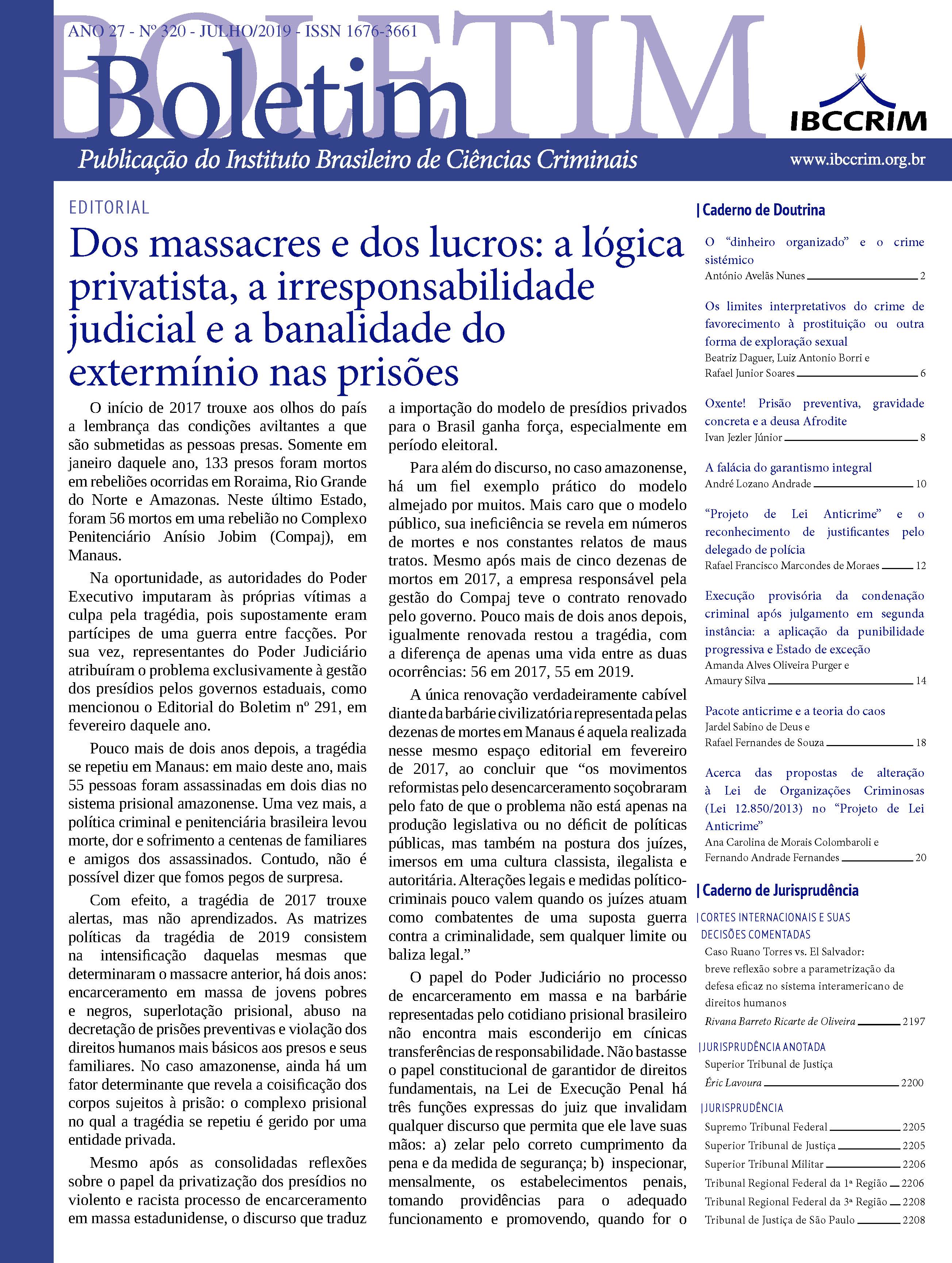
Provisional enforcement of criminal convictions after trial in the court of second instance
the application of progressive punishment and the state of exception
Keywords:
early enforcement, presumption of innocence, punitive system, state of emergency, constitutional guaranteesAbstract
This study addresses the practice of provisional enforcement of sentences after conviction in the second instance in Brazil and questions its articulation with the principle of presumption of innocence. It analyzes how this regime (“progressive punishment”) modifies the moment when criminal sanctions begin, altering the dynamics between individual freedom and state punitive power. The legislative proposal of the “anti-crime package” is examined from the perspective of a state of criminal exception, in which the criminal system acts as an instrument of social control rather than resocialization. Based on Hobbesian philosophical reflection and contemporary theory on exceptions, it is argued that extending enforcement before a final judgment reinforces a logic of anticipating punishment and weakens fundamental constitutional guarantees. It is concluded that such changes require critical attention to the protection of rights and the legitimacy of the use of repressive power.
Downloads
References
Agamben, Giorgio. Estado de exceção. 2. ed. São Paulo: Boitempo, 2004.
Beccaria, Cesare. Dos delitos e das penas. Tradução de J. Cretella Júnior e Agnes Cretella. 6. ed. São Paulo: Revista dos Tribunais, 2013.
BRASIL. Constituição (1988). Constituição da República Federativa do Brasil. Brasília, DF: Senado Federal. Disponível em: <http://www.planalto.gov.br/ccivil_03/Constituicao/Constituicao.htm>. Acesso em: 17 mai. 2018.
______. Decreto-Lei 3689, de 03 de out. 1941. Código de Processo Penal. Disponível em: <http://www.planalto.gov.br/ccivil_03/Decreto-Lei/Del3689.htm>. Acesso em: 17 mai. 2018.
______. Lei 7.210, de 11 DE julho de 1984. Lei de Execuções Penais. Disponível em: <http://www.planalto.gov.br/ccivil_03/Leis/L7210compilado.htm>. Acesso em: 07 jun. 2018.
______. Supremo Tribunal Federal. Habeas Corpus n. 126.292/SP. Relator: MIN. TEORI ZAVASCK. Publicado no DJ de 16 de fevereiro de 2016. Disponível em: <http://www.stf.jus.br/arquivo/cms/publicacaoInformativoTema/anexo/Informativomensalfever eiro2016.pdf>. Acesso em: 05 mai. 2018.
______. Supremo Tribunal Federal. Habeas Corpus n. 152.752/PR. Relator: MIN. EDSON FACHIN. Publicado no DJ de 09 de abril de 2018. Disponível em: <http://portal.stf.jus.br/processos/detalhe.asp?incidente=5346092>. Acesso em: 05 mai. 2018.
______. Superior Tribunal de Justiça. Súmula 401, Corte Especial, julgado em 07.10.2009, DJe 13.10.2009, RSTJ vol. 216.. Disponível em: <https://ww2.stj.jus.br/docs_internet/revista/eletronica/stj-revista-sumulas-2013_37_capSumula401.pdf>. Acesso em: 05 mai. 2018.
CONVENÇÃO AMERICANA SOBRE DIREITOS HUMANOS. 22 nov. 1969. Disponível em: <https://www.cidh.oas.org/basicos/portugues/c.convencao_americana.htm>. Acesso em: 05 mai. 2018.
Dinamarco, Cândido Rangel. Capítulos de sentença. 4. ed. São Paulo: Malheiros, 2009.
DECLARAÇÃO UNIVERSAL DOS DIREITOS HUMANOS. Assembleia Geral das Nações Unidas em Paris. 10 dez. 1948. Disponível em: https://www.pcp.pt/actpol/temas/dhumanos/declaracao.html. Acesso em: 05 mai. 2018.
Ferrajoli, Luigi. Direito e razão. São Paulo: Revista dos Tribunais, 2014.
Gomes, Luiz Flávio. Penas e medidas alternativas à prisão: doutrina e jurisprudência. 2. ed. v. 1. Ver., atual. e ampl. São Paulo: Revista dos Tribunais, 2000.
Greco, Rogério. Curso de direito penal: parte geral. v. 1. 15. ed. Niterói: Ímpetos, 2018.
Hobbes, Thomas. Leviatã ou matéria, forma e poder de um estado eclesiástico e civil. São Paulo: Martins Fontes, 2008.
Montesquieu, Charles de Secondat. O espírito das leis. São Paulo: Martins Fontes, 2000.
Sarlet, Ingo Wolfgang; Marinoni, Luiz Guilherme; Mitidiero, Daniel. Curso de direito constitucional. 6. ed. São Paulo: Saraiva, 2017.
Silva, José Afonso da. Curso de direito constitucional positivo. 9 ed. rev. São Paulo: Malheiros, 1992.
Streck, Lenio Luiz. Presunção de inocência: Fachin interpreta a Constituição conforme o CPC. Disponível em: Acesso em: 16 mai. 2018.
Downloads
Published
How to Cite
Issue
Section
License

This work is licensed under a Creative Commons Attribution-NonCommercial 4.0 International License.
Copyright of published articles belongs to the author, but with journal rights over the first publication and respecting the one-year exclusivity period. Authors may only use the same results in other publications by clearly indicating this journal as the medium of the original publication. If there is no such indication, it will be considered a situation of self-plagiarism.
Therefore, the reproduction, total or partial, of the articles published here is subject to the express mention of the origin of its publication in this journal, citing the volume and number of this publication. For legal purposes, the source of the original publication must be consigned, in addition to the DOI link for cross-reference (if any).