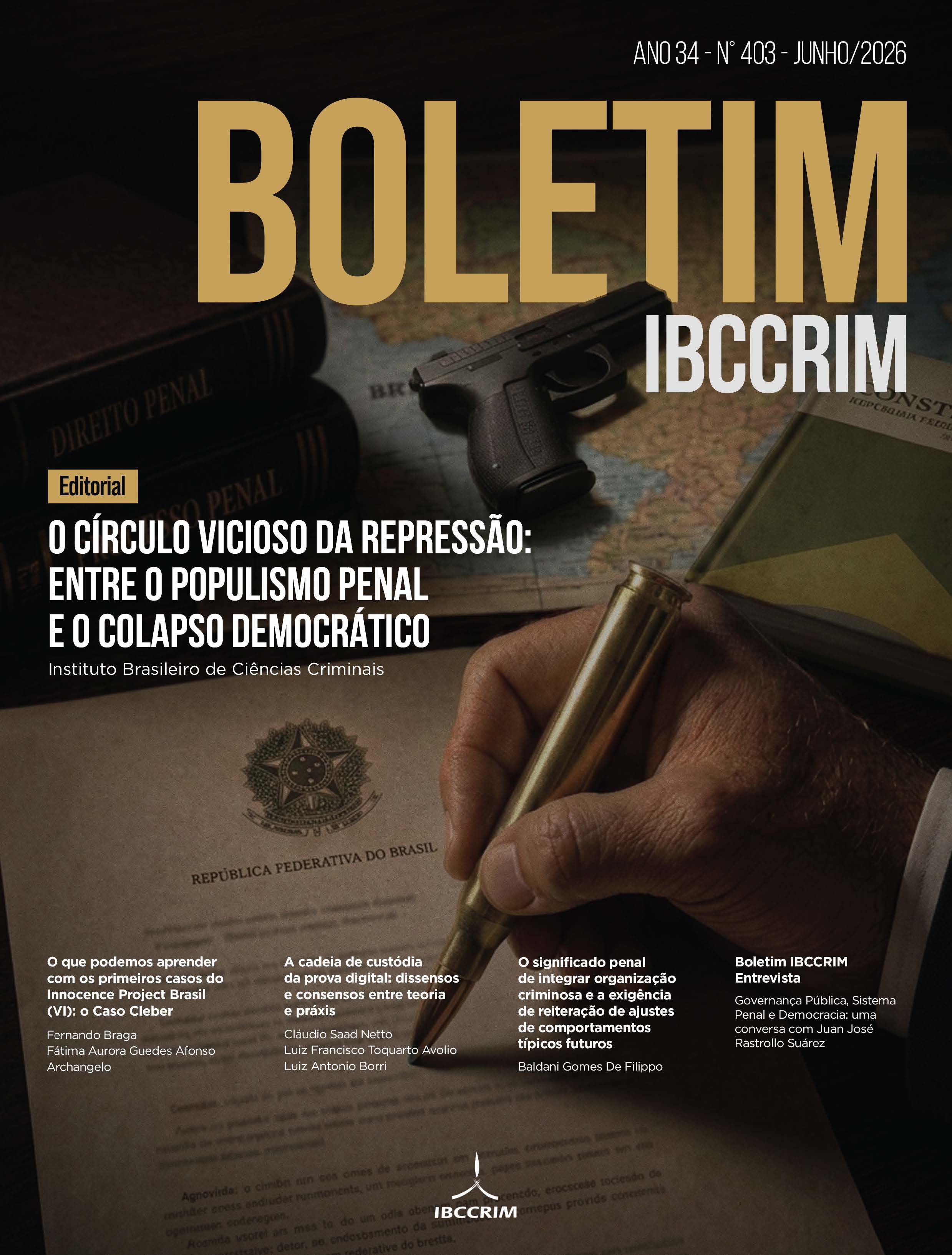
What can we learn from the first cases of the Innocence Project Brazil (VI)
the Cleber Case
DOI:
https://doi.org/10.5281/zenodo.20276229Keywords:
criminal evidence, evaluation of evidence, eyewitness identification, presumption of innocence, learning from errorsAbstract
The article analyzes the Cleber case, critically examining the first- and second-instance judgments that resulted in his conviction for sexual abuse of a vulnerable person, identifying flaws in the decisional and justificatory reasoning, particularly regarding: the uncritical acceptance of the victim’s testimony without any epistemic monitoring of the declarant’s honesty, perceptual accuracy, and mnemonic reliability; the distortion of the case record evidence; the disregard of alibi evidence; and the absence of genuine engagement with the issues raised by the defense throughout the proceedings. The study concludes by mapping the factors that likely contributed to the error: automatic admissibility of charges, the ordering and maintenance of pretrial detention, inadequate evaluation of memory-dependent evidence, the absence of a structured decision-making method, and a misunderstanding of the criminal judge’s role.
Downloads
References
ANDERSON, Terence; SCHUM, David; TWINING, William. Analysis of evidence. Cambridge: Cambridge University Press, 2005. https://doi.org/10.1017/CBO9780511610585
BARR, Noah; COOPER, Glinda. Identifying how an individual becomes a suspect: a needed addition to the innocence literature. Wrongful Conviction Law Review, v. 4, n. 1, p. 48-70, 2023. https://doi.org/10.29173/wclawr90
BRAGA DAMASCENO, Fernando. Direito probatório (stricto sensu): da valoração da prova. São Paulo: Tirant lo Blanch, 2023a.
BRAGA DAMASCENO, Fernando. Pensando a qualidade do juízo fático-probatório: um modelo de evolução baseado no aprendizado com erros. Revista Brasileira de Direito Processual Penal, Porto Alegre, v. 9, n. 3, p. 1213-1256, 2023b.
CECCONELLO, William Weber; ÁVILA, Gustavo Noronha de; STEIN, Lilian Milnitsky. A (ir)repetibilidade da prova penal dependente da memória: uma discussão com base na psicologia do testemunho. Revista Brasileira de Políticas Públicas, Brasília, v. 8, n. 2, p. 1057-1073, 2018. https://doi.org/10.5102/rbpp.v8i2.5312
CECCONELLO, William Weber; FITZGERALD, Ryan J.; STEIN, Lilian Milnitsky. Efeitos do alinhamento justo e similaridade de rostos no reconhecimento de pessoas. Psico-USF, Campinas, v. 27, n. 1, p. 181-191, 2022. https://doi.org/10.1590/1413-82712022270114
DAHLMAN, Christian. Unacceptable generalizations in arguments on legal evidence. Argumentation, v. 31, n. 1, p. 83-99, 2017. https://doi.org/10.1007/s10503-016-9399-1.
EISEN, Mitchell L.; SKERRIT-PERTA, Amaia; JONES, Jennifer M.; OWEN, Jade; CEDRÉ, Gabriela C. Pre-admonition suggestion in live showups: when witnesses learn the cops believe they caught ‘the’ guy. Applied Cognitive Psychology, v. 31, n. 5, p. 520-529, 2017. https://doi.org/10.1002/acp.3349
FONDEVILA, Gustavo; QUINTANA-NAVARRETE, Miguel. Determinantes de la sentencia: detención en flagrancia y prisión preventiva en México. Latin American Law Review, Bogotá, v. 1, n. 4, p. 49-72, 2020. https://doi.org/10.29263/lar04.2020.03
FRICKER, Elizabeth. Against gullibility. In: MATILAL, Bimal Krishna; CHAKRABARTI, Arindam (org.). Knowing from words. Dordrecht: Kluwer Academic Publishers, 1994. p. 125-161.
GLOECKNER, Ricardo Jacobsen. Prisões cautelares, confirmation bias e o direito fundamental à devida cognição no processo penal. Revista Brasileira de Ciências Criminais, São Paulo, v. 23, n. 117, p. 263-286, 2015.
HOCK LAI, Ho. The legal concept of evidence. In: Stanford Encyclopedia of Philosophy, 2021. Disponível em: https://plato.stanford.edu/entries/evidence-legal/. Acesso em: 19 abr. 2026.
KASSIN, Saul M.; TUBB, V. Anne; HOSCH, Harmon M.; MEMON, Amina. On the ‘general acceptance’ of eyewitness testimony research: a new survey of the experts. American Psychologist, v. 56, n. 5, p. 405-416, 2001. https://doi.org/10.1037/0003-066X.56.5.405
LEIPOLD, Andrew D. How the pretrial process contributes to wrongful convictions. American Criminal Law Review, v. 42, p. 1123-1165, 2005.
LIDÉN, Moa. Confirmation bias in criminal cases. 2018. Tese (Doutorado) – Uppsala University, Uppsala, 2018.
LOFTUS, Elizabeth F. Eyewitness testimony. Cambridge: Harvard University Press, 1979.
MAIER, Benjamin G.; NIEHAUS, Susanna; WACHHOLZ, Sina; VOLBERT, Renate. The strategic meaning of CBCA criteria from the perspective of deceivers. Frontiers in Psychology, v. 9, art. 855, 2018. http://doi.org/10.3389/fpsyg.2018.00855
WAGENAAR, Willem A.; KOPPEN, P. J. van; CROMBAG, Hans F. M. Anchored narratives: the psychology of criminal evidence. Hemel Hempstead: Harvester Wheatsheaf, 1993.
Downloads
Published
How to Cite
Issue
Section
License

This work is licensed under a Creative Commons Attribution-NonCommercial 4.0 International License.
Copyright of published articles belongs to the author, but with journal rights over the first publication and respecting the one-year exclusivity period. Authors may only use the same results in other publications by clearly indicating this journal as the medium of the original publication. If there is no such indication, it will be considered a situation of self-plagiarism.
Therefore, the reproduction, total or partial, of the articles published here is subject to the express mention of the origin of its publication in this journal, citing the volume and number of this publication. For legal purposes, the source of the original publication must be consigned, in addition to the DOI link for cross-reference (if any).